


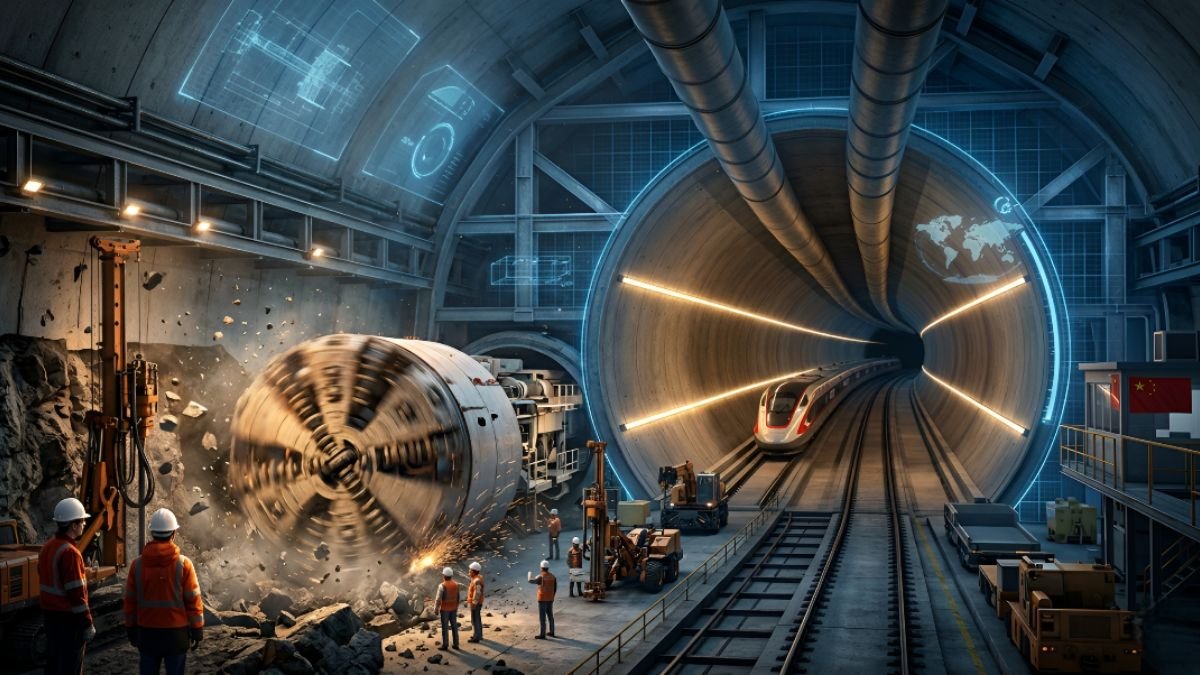
History is replete with moments when humanity, rather than bowing before nature’s greatest obstacles, chose instead to conquer them. When the Romans constructed colossal aqueducts, when the Egyptians erected the pyramids, and when the Americans laid the transcontinental railway, they all demonstrated that the combined power of human resolve and engineering can transform the impossible into reality. And now, in the twenty-first century, China has accomplished a feat that places all these historical achievements in a new perspective. China has completed a massive tunnel project, spanning 450 kilometres, which not only writes a new chapter in the history of engineering but also fundamentally redefines the methods of infrastructure development worldwide. This tunnel is not merely a structure of stone and concrete; it stands as a symbol of China’s indomitable will—a will that establishes it as the world’s foremost engineering power. The story behind this project is as compelling as its technical achievement, and understanding it serves as a key to understanding the future of the world.
Project Background: A Dream Nurtured Over Decades
China’s geographical diversity has long posed a significant challenge to its development. To the east lie vast plains and coastal regions where the pace of economic growth has been rapid, while to the west lie the Tibetan Plateau, the foothills of the Himalayas, and immense mountain ranges that effectively cut these regions off from the rest of the country. Delivering resources and services to the tens of millions of people inhabiting these inaccessible terrains has always been a formidable challenge. In their quest to resolve this very issue, Chinese engineers and policymakers envisioned a tunnel that would carve a direct route straight through the mountains. This dream remained confined to plans and files for decades, as the technical and economic hurdles associated with such a project were deemed unimaginable. However, as China accelerated the rollout of its Belt and Road Initiative (BRI) and committed to massive investments in domestic infrastructure, this long-held dream began to take shape as a concrete, tangible project. After years of planning, countless engineering surveys, and an investment running into thousands of crores of rupees, this project has finally come to fruition—and its completion has now captured the attention of the entire world.

450 Kilometres: A Number That Boggles the Imagination
450 kilometres. This figure sounds simple enough, but when you attempt to grasp its reality, the mind reels. The distance from Delhi to Jaipur is approximately 280 kilometres; from Delhi to Agra, it is about 200 kilometres. Now, imagine being able to traverse the entire distance from Delhi to Udaipur—completely underground, cutting through rock and soil. That is the sheer scale of this tunnel. The world’s longest tunnel to date has been Switzerland’s Gotthard Base Tunnel, which spans approximately 57 kilometres and took 17 years to construct. This new tunnel in China is nearly eight times longer than that. Such a comparison helps one truly appreciate the grandeur of this project. The sheer volume of earth and rock excavated during the tunnel’s construction could have formed several small mountains; the amount of concrete poured could have built several large dams. This is not merely a construction project; it is a monumental human endeavour—the greatest engineering achievement of our time.
Technical Challenges: Obstacles That Tested the Engineers
The construction of this tunnel did not take place on flat terrain. This tunnel traverses regions prone to seismic activity, areas characterised by immense groundwater pressure, locations where temperatures plummet below freezing, and mountainous zones possessing extremely complex and unpredictable geological structures. To confront these challenges, Chinese engineers employed techniques that had never before been attempted on such a massive scale. Tunnel Boring Machines (TBMs)—specifically designed and manufactured for this undertaking—were utilised in this project. These machines function like colossal rotating drills, cutting through rock as they advance. However, when the geological composition proved so intricate that even TBMs failed to make headway, engineers resorted to the traditional “drill and blast” technique. Advanced shotcrete and rock bolt technologies were employed to reinforce the tunnel walls. Specialised waterproofing systems were installed to manage groundwater. Furthermore, a sophisticated ventilation system was integrated throughout the tunnel to maintain air quality and facilitate the extraction of smoke during emergency situations.
The Role of Artificial Intelligence and Robotics
This project is remarkable not merely for its sheer length, but also because the technology deployed in its construction establishes a new benchmark for future infrastructure projects. China made extensive use of artificial intelligence (AI) throughout this endeavour. AI-powered sensor systems continuously monitored the tunnel walls for cracks and structural weak points, providing early warnings regarding any potential hazards. This resulted in a significant enhancement of workplace safety. Robotic systems were deployed to perform tasks in areas deemed too hazardous for human workers. Drone technology was utilised for surveying and monitoring the progress of the tunnel construction. Building Information Modelling (BIM) software generated a “digital twin”—a virtual replica—of the entire tunnel, which was updated in real-time. This capability greatly simplified the process for engineers to identify potential issues and devise effective solutions. This technical approach has emerged as an exemplary model for future construction projects.
The Human Aspect: The Millions of Hands That Made History
Behind any great engineering feat lies a force even greater than machines and technology: human labour, dedication, and courage. At its peak, this project saw more than 50,000 labourers and engineers working simultaneously. These individuals hailed from various parts of China—some were seasoned tunnel builders, while others were young engineers undertaking a project of such magnitude for the very first time. They laboured hundreds of metres beneath the earth, amidst dark and humid conditions—at times enduring scorching temperatures of 40 degrees and, at others, temperatures plummeting below freezing. Safety was a paramount concern, given the inherent and significant hazards associated with underground construction. Sudden water ingress, roof collapses, and toxic gas leaks were all tangible threats that had to be confronted on a daily basis. According to Chinese authorities, safety standards were strictly adhered to throughout the project, and with the aid of modern technology, accidents were kept to a minimum. The contributions of these thousands of unsung labourers and engineers constitute the true foundation of this project.
Environmental Considerations: Balancing Development and Nature
The most controversial aspect of any major engineering project is its impact on the environment, and this 450-kilometre tunnel is no exception. Critics have raised questions regarding the potential effects of excavation and construction work on such a massive scale—specifically, how it might impact local geological structures, groundwater levels, and the surrounding ecosystem. Chinese officials maintain that a comprehensive environmental impact assessment was conducted during the planning phase of the project. The tunnel’s route was carefully selected to avoid sensitive ecological zones as much as possible. Soil and rock excavated during construction were repurposed for other building projects to minimise waste. Furthermore, a groundwater management system was designed to ensure that water levels in the areas surrounding the tunnel remained unaffected. Although critics remain concerned about potential long-term environmental consequences, it is also true that a tunnel route causes significantly less environmental disruption—in many respects—than a traditional surface road or railway line, as it does not fragment the land’s surface.
Impact on Global Infrastructure: The World Watches and Learns
The impact of this Chinese project extends far beyond China’s borders. Engineers, policymakers, and infrastructure experts worldwide are closely studying this undertaking. In Europe—where the Alps mountain range has historically hindered connectivity between the north and the south—the feasibility of constructing new, long-distance tunnels is now being actively explored. Japan, already a pioneer in tunneling technology, is drawing inspiration from this Chinese project. Norway, which faces unique transportation challenges due to its fjords (narrow inlets), is considering applying China’s experience to its own infrastructure development. India, seeking to enhance connectivity between its Himalayan states and the rest of the country, also stands to learn a great deal from this project. Whether in Jammu and Kashmir, Uttarakhand, or Sikkim, long-distance tunnels could play a pivotal role in significantly improving road and rail connectivity across these states. This project in China has conclusively demonstrated that, with the right combination of technology and determination, no geological barrier is insurmountable.

Economic Impact: A Tunnel That Could Transform Economies
The most immediate and significant benefit of this project will accrue to those regions that, due to geographical inaccessibility, have hitherto remained cut off from the economic mainstream. When the movement of goods and people becomes easier and faster, trade flourishes, employment opportunities are generated, and living standards improve. The opening of this tunnel will breathe new life into China’s western provinces, which have previously lagged behind in the race for development. The tourism industry, too, will receive a major boost, as accessing these once-inaccessible terrains will now become significantly easier. It will also become possible to harness the mineral-rich regions where industries could not be established until now due to transportation difficulties. Furthermore, this tunnel will further bolster China’s BRI—the Belt and Road Initiative—an ambitious network designed to foster trade linkages with Central Asia and Europe. From an economic perspective, this project is expected to recoup its construction costs within just a few decades, after which it will stand as a lasting asset for China’s economy.
Lessons for India: Can We Follow This Path?
In light of this mega-project by China, there are several crucial lessons for India’s policymakers and engineers. India’s geographical challenges are no less formidable. The Himalayas, the Western Ghats, and the hills of the North-easttunnelling isolate millions of people from mainstream development. India is already working on several ambitious tunnelling projects, such as the Atal Tunnel—which passes beneath the Rohtang Pass—and the Z-Morh Tunnel, which provides year-round connectivity to Sonmarg. However, compared to China’s 450-kilometre undertaking, these Indian projects remain relatively small in scale. The greatest lesson India can draw from this Chinese project is the importance of long-term vision, the capacity for centralised decision-making, and the political will to invest in technological innovation. If India embraces these lessons and invests in its infrastructure on a similar scale, the day is not far when India, too, will be in a position to execute such ambitious projects.
A Tunnel Etched in History
China’s 450-kilometre mega-tunnel is not merely a construction project; it is a new definition of human potential. It represents a triumph for the millions of engineers, labourers, and scientists who toiled for years under arduous conditions to turn their dream into reality. It is a victory for the Chinese mindset—one that sets ambitious goals and mobilises both the resources and the resolve required to achieve them. Furthermore, it serves as an inspiration to the entire world, demonstrating that no obstacle is insurmountable and no mountain is too high to be traversed. When future generations pass through this tunnel—covering in mere minutes a distance that once took hours or even days—they may not even realise the magnitude of the colossal human achievement over which they are travelling. Yet, history knows—as does the world of engineering—that this marks a moment when humanity once again proved that, when combined, imagination and determination can transcend any boundary.
FAQs
Q. What makes China’s 450km tunnel a historic engineering achievement?
A. China’s 450km tunnel is approximately eight times longer than the world’s previously longest tunnel, Switzerland’s Gotthard Base Tunnel which is only 57km long. It required over 50,000 workers and engineers working simultaneously and involved cutting through some of the most geologically complex and challenging terrain ever encountered in tunnel construction history.
Q. What advanced technologies were used to build this massive tunnel?
A. The project used specially designed Tunnel Boring Machines, AI-powered sensor systems for real-time crack and weakness detection, robotic systems for dangerous work zones, drone technology for progress monitoring, and Building Information Modeling software that created a live digital twin of the entire tunnel updated continuously throughout construction.
Q. How many workers were involved and what conditions did they face?
A. At peak construction, over 50,000 workers and engineers worked simultaneously deep underground in extremely difficult conditions including temperatures swinging between intense heat and freezing cold, constant risks of sudden water infiltration, roof collapse, toxic gas leaks, and working hundreds of metres below ground in dark and humid environments for extended periods.
Q. What economic impact will this tunnel have on China’s development?
A. The tunnel will open previously inaccessible western regions to economic development, dramatically reduce transport costs for mineral extraction, boost tourism to remote areas, strengthen China’s Belt and Road Initiative trade connections with Central Asia and Europe, and create thousands of new jobs in regions that were historically left behind in China’s rapid economic growth.
Q. What lessons can India learn from China’s tunnel achievement?
A. India faces similar geographical challenges with Himalayan states like Jammu-Kashmir, Uttarakhand and Sikkim being poorly connected to the rest of the country. China’s success demonstrates that long-term vision, centralised decision-making, investment in technological innovation, and strong political willpower are the key ingredients India needs to develop its own ambitious tunnel infrastructure connecting its most remote and geographically challenging regions.